Advancing understanding of Model Risk

26 February 2026
The Credit Research Centre (CRC) continues to demonstrate its commitment to thought leadership in credit risk, analytics, and financial services through the delivery of targeted educational events that bridge academic insight and professional practice.
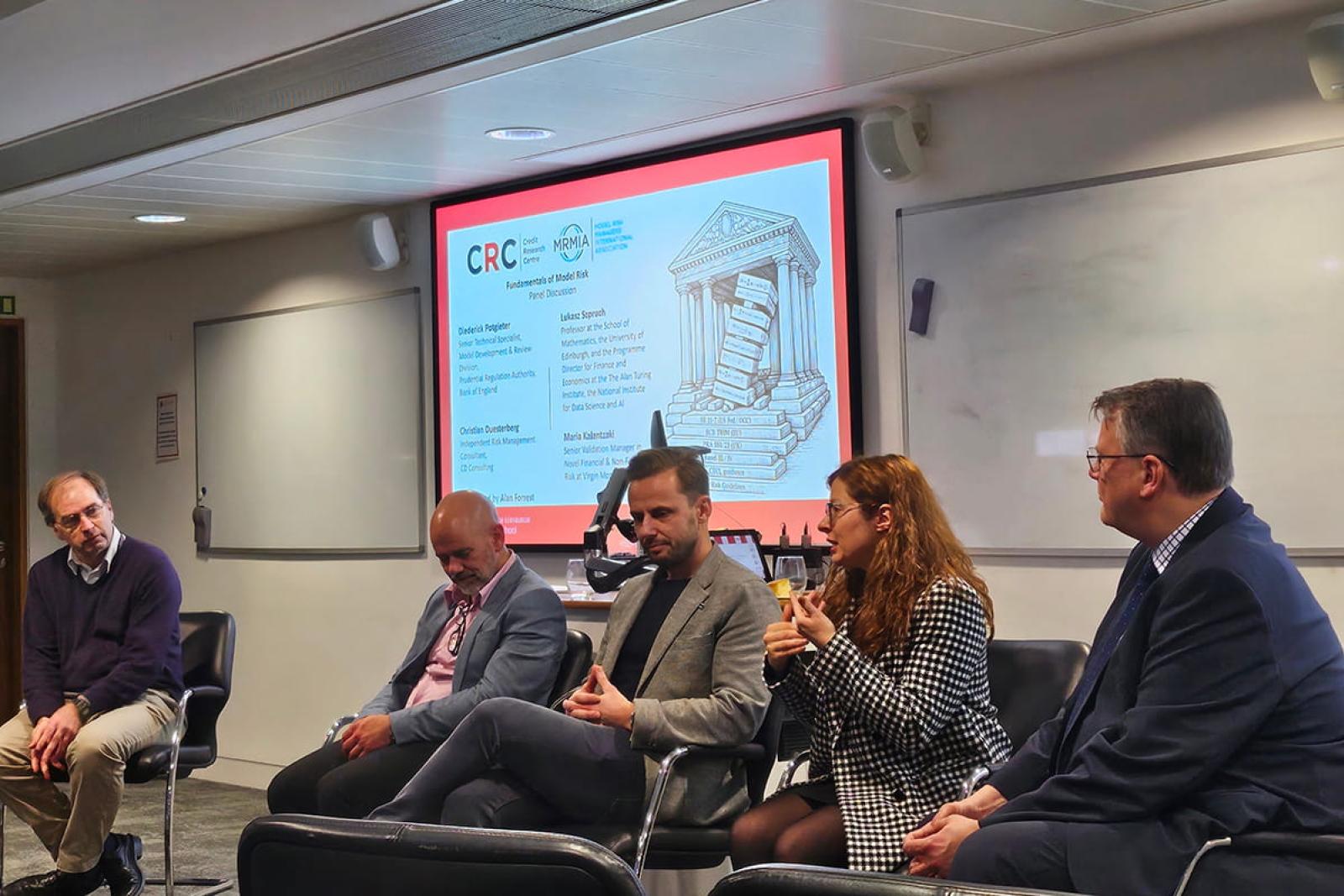
Panel of presenters at a CRC event

On the 19 February 2026, CRC partnered with the Model Risk Managers International Association (MRMIA) to host a comprehensive in-person session titled Fundamentals of Model Risk, bringing together regulators, industry experts, and scholars for a full-day exploration of one of the most pressing analytical challenges facing the financial sector today.

Why Model Risk matters

Models are central to decision-making across finance, analytics, and research, yet they are not infallible. Beyond routine testing and validation, models can embody incorrect assumptions, unstable specifications, shifting data environments, or improper application. Collectively, such vulnerabilities contribute to Model Risk, defined as the potential for loss resulting from the use of an unsound or misused model. As predictive analytics and machine learning expand in complexity and influence, a clear understanding of Model Risk is essential for robust decision-making, effective governance, and responsible innovation.

Building a strong foundation: Expert insight and practical guidance

CRC’s collaborative session engaged leading figures in model governance and quantitative risk, including:

  • Dr Diederick Potgieter, Senior Technical Specialist in Capital Management at the Prudential Regulation Authority (PRA), Bank of England
  • Christian Duesterberg, Risk Management Consultant with over 26 years’ experience in financial services
  • Dr Alan Forrest, CRC Business Associate, MRMIA Board Member, and former senior model development and validation lead at Virgin Money UK, Royal Bank of Scotland, and Halifax Bank of Scotland
  • Additional international experts in model risk and quantitative risk management

Through structured beginner sessions and an in-depth panel discussion, participants gained insight into how Model Risk manifests across modelling approaches, from classical statistical frameworks to advanced machine learning and generative AI. Indeed, the session included examples from law and engineering as well as financial services. Presentations examined how Model Risk is understood and regulated in the UK financial services sector, how seasoned practitioners identify and assess risk within model lifecycles, and how a Model Risk mindset enhances transparency, trust, and operational resilience.

Lukasz Szpruch, Professor at the School of Mathematics, the University of Edinburgh, and the Programme Director for Finance and Economics at The Alan Turing Institute, the National Institute for Data Science and AI, and Dr Maria Kalantzaki, Senior Validation Manager in Novel Financial & Non-Financial Risk at Virgin Money joined the evening session as panellists.

The featured discussion, moderated by Dr Alan Forrest, brought together regulators, academics, and industry leaders to reflect on both conceptual and practical dimensions of Model Risk. The panel session encouraged open dialogue under Chatham House rules, emphasising real-world implications and cross-sector learning.

Thought leadership that makes an impact

Events such as Introduction to Model Risk are not simply educational forums; they play a structural role in shaping how risk is understood and managed across the financial sector. By bringing regulators, industry leaders, and academics into the same room, CRC helped strengthen a shared language around Model Risk — one that moves beyond compliance toward deeper analytical accountability.

The discussion reinforced that Model Risk is not a niche technical concern, but a foundational element of modern decision-making. As modelling becomes more complex, particularly with the rise of AI and machine learning, a disciplined approach to identifying assumptions, understanding limitations, and communicating uncertainty becomes central to institutional resilience. By foregrounding these principles, the event contributed to embedding Model Risk thinking more firmly within professional practice.

Importantly, the collaboration between CRC and MRMIA demonstrated how academic insight and regulatory experience can jointly influence industry standards. Financial institutions increasingly operate in environments where model governance is both a regulatory requirement and a strategic necessity. Events like this support the cross-fertilisation of ideas and diffusion of best practice across organisations, helping practitioners adopt more structured, transparent, and defensible approaches to model development and deployment.

In doing so, CRC’s work extends beyond convening discussion - it contributes to shaping expectations, strengthening governance cultures, and supporting more robust, trustworthy analytical systems across the market.

Looking ahead

CRC remains dedicated to advancing research and practice at the intersection of credit risk, analytics, and financial services. Through events like Fundamentals of Model Risk and our ongoing Village Hall series Let’s Talk About, the CRC is proud to serve as a neutral hub for open and critical discussions.

The Credit Research Centre extends our heartfelt gratitude to MRMIA for sponsoring this event.

CRC and MRMIA unite for dedicated day on Model Risk

20 February 2026

The Credit Research Centre (CRC) partnered with the Model Risk Managers International Association (MRMIA) to deliver a full-day, in-person event devoted to understanding and managing Model Risk. On 19 February 2026, the sessions brought together regulators, academics, and industry practitioners to explore one of the most critical and evolving disciplines in modern analytics and financial services.

Titled Fundamentals of Model Risk, the event examined how models - from simple regressions to advanced machine learning and generative AI systems - can fail, and how such failures translate into measurable risk. Model Risk, defined as the potential loss caused by incorrect, inappropriate, incomplete or misused models, is increasingly recognised as both a professional discipline and a regulatory priority, particularly within financial services.

Expert perspectives from industry and regulation

The programme featured contributions from leading specialists, including:

  • Dr Diederick Potgieter, Senior Technical Specialist in Capital Management at the Prudential Regulation Authority (PRA), Bank of England
  • Christian Duesterberg, Risk Management Consultant with over 26 years’ experience in financial services
  • Dr Alan Forrest, CRC Business Associate, MRMIA Board Member, and former senior model development and validation lead at Virgin Money UK, Royal Bank of Scotland, and Halifax Bank of Scotland
  • Additional international experts in model risk and quantitative risk management

Drawing on deep experience from the banking sector, speakers addressed how Model Risk manifests in practice, how it is regulated in UK financial services, and what benefits a strong Model Risk mindset can bring to modelling and decision-making.

Developing the Model Risk mindset

The workshop sessions introduced participants to the structured thinking behind Model Risk management, and its importance across industries. Discussions covered:

  • The Model Risk mindset and the model lifecycle
  • Case studies from financial services, engineering & law
  • Model Risk as a form of risk management
  • Regulatory oversight by the Bank of England
  • The costs and benefits of embedding Model Risk discipline

Participants were encouraged to reflect critically on their own modelling practices and consider how systematic identification, assessment, and mitigation of model weaknesses can improve both analytical rigour and business outcomes.

Panel discussion and industry dialogue

The evening panel session brought together regulators, academics, and industry leaders for a candid discussion under Chatham House rules. Panellists included:

  • Diederick Potgieter, (Bank of England PRA)
  • Christian Duesterberg, (Independent Consultant)
  • Lukasz Szpruch, (The Alan Turing Institute)
  • Maria Kalantzaki, (Virgin Money UK / Nationwide)

Moderated by Dr Alan Forrest, the panel explored the practical implications of Model Risk governance, the challenges of implementation across institutions, and the future direction of regulation and professional practice.

The day concluded with a drinks reception, providing attendees the opportunity to continue discussions and build connections across academia, industry, and regulatory communities.

Strengthening the model risk community

The event demonstrated CRC’s continued commitment to fostering dialogue between research and professional practice. By uniting academic insight with regulatory and industry experience, CRC and MRMIA highlighted how a mature Model Risk framework not only protects organisations but strengthens trust, transparency, and decision-making quality across sectors.

The Credit Research Centre extends our heartfelt gratitude to MRMIA for sponsoring this event.

Call for Chapters open: Advances in Credit Risk Analytics

13 January 2026

The Credit Research Centre (CRC) is pleased to announce the Call for Chapters for an upcoming edited volume titled Advances in Credit Risk Analytics – Methodologies and Applications for the Future of Credit Risk Management.

This volume aims to bring together cutting-edge research and practical insights that reflect the evolving challenges and opportunities in credit risk analytics. It will showcase methodological advances, real-world applications, and forward-looking perspectives from both academic researchers and industry practitioners.

CRC strongly encourages contributors to the 19th Credit Scoring and Credit Control Conference, including both academic and practitioner presenters, to submit a chapter based on their conference work. High-quality submissions not presented at the conference will also be considered; submissions falling outside the conference themes may be desk-rejected.

The submission deadline is 31 March 2026.

Full details on the scope of the volume, submission criteria, and the submission process

CRC looks forward to receiving contributions that help advance research, practice, and dialogue in credit risk management and analytics.

CRC Winter Village Hall explores AI in financial services

16 December 2025

CRC’s Winter 'Let’s Talk About' Village Hall brought together leading academics and industry practitioners for a thoughtful discussion on the opportunities and challenges of integrating artificial intelligence into financial services.

The event featured expert contributions from:

  • Professor Michael Rovatsos, Dean of Research and Innovation at the College of Science and Engineering and Professor of Artificial Intelligence at the School of Informatics, University of Edinburgh
  • Dr Maria Kalantzaki, Senior Validation Manager in Novel Financial & Non-Financial Risk at Virgin Money
  • Roberto Wolf, Principal of AI Innovation at Optima Partners
  • Professor Alexandra Birch, Chair of Multilingual Natural Language Processing in the Institute for Language, Cognition and Computation (ILCC) at the School of Informatics, University of Edinburgh, and co-founder and Chief Scientist of Aveni.ai
  • Soner Candan, Lead Data & AI Scientist at Lloyds Banking Group

The event was moderated by Professor Galina Andreeva, Director of the Credit Research Centre.

We are pleased to share slides from a selection of speakers with our global community:

We look forward to welcoming participants to upcoming CRC events.

Subscribe to